
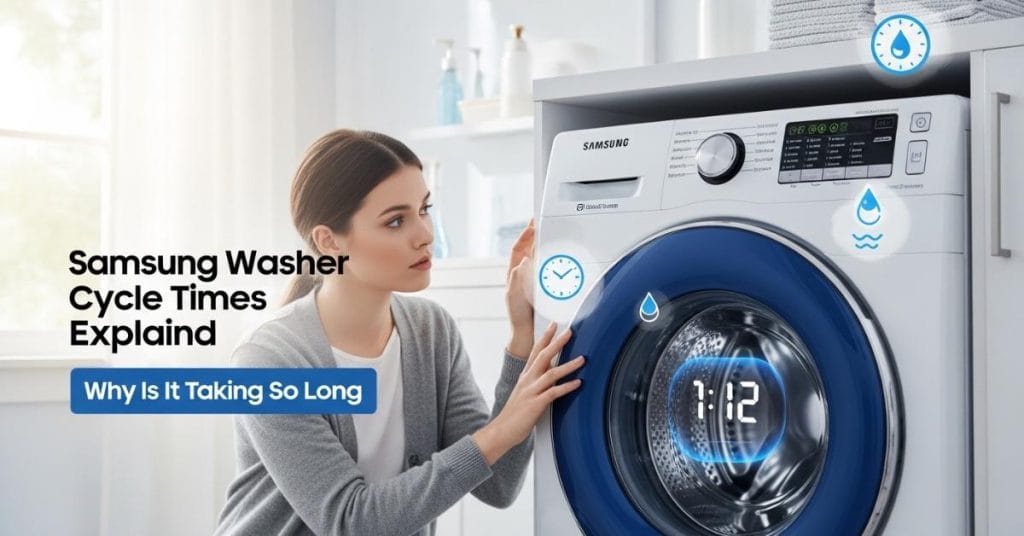
If you’ve ever looked at your washer and wondered, “Why is it taking so long?”—you’re not alone. There’s a simple reason why searches for Samsung washing machine cycle times have skyrocketed: People are confused by the performance they expect, but often don’t.
Here’s a truth that most articles don’t make clear: There’s no one “right” cycle time. Your machine dynamically adjusts itself based on the size of your load, the type of fabric, and internal sensors. It’s smart engineering—but it makes it harder to tell when something’s really wrong.
This guide explains the subject realistically and practically. You’ll understand what’s normal, what’s abnormal, and how to fix common problems like Samsung washing machine cycles taking too long or not finishing—without any guesswork or wasted money.
What Are Normal Samsung Washing Machine Cycle Times?
Let’s get a general idea first. While times vary by model and settings, these time frames apply to most Samsung washers:
Normal cycles typically take 50 to 70 minutes. Quick wash cycles are much shorter, often finishing in 15 to 30 minutes. Heavy-duty cycles can last anywhere from 90 minutes to 2 hours, especially for thick fabrics like towels or jeans. Eco mode, which is designed to save energy, often surprises people—it can take 2 to 3 hours. Delicate cycles typically take 45 to 60 minutes.
At first glance, this may seem pretty straightforward. But this is where people make a mistake—they assume that less time means better performance. This is not true. Longer cycles, especially Eco cycles, are intentionally designed to use less water and lower temperatures. This takes longer.
Why Your Samsung Washing Machine Cycle Time Changes
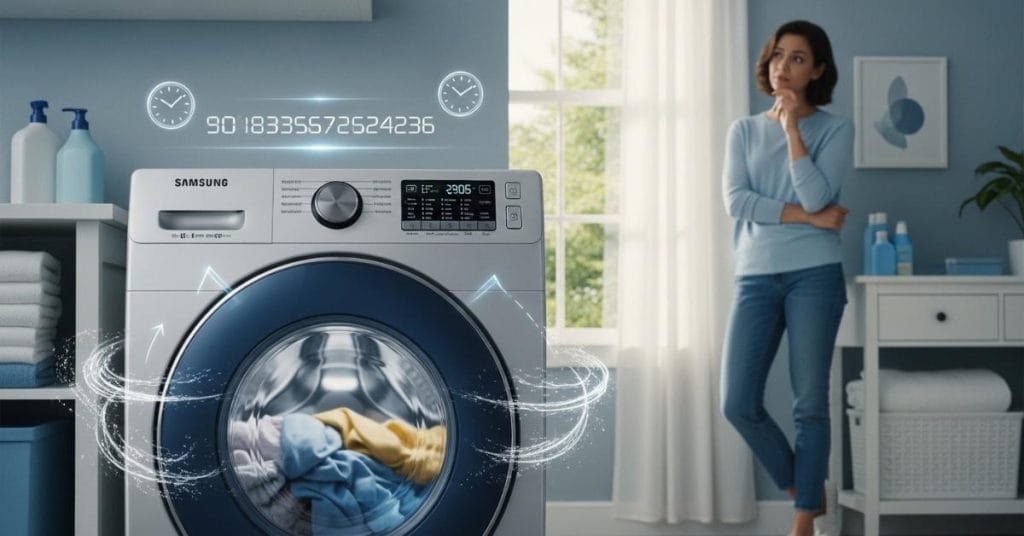
Modern washing machines don’t follow a set timer. Samsung machines use sensors to adjust the cycle in real time. This means that the same “normal” setting might take 55 minutes one day and 75 minutes the next.
The factors that actually affect the time are:
The amount of laundry plays a big role. It takes longer to wash and clean more clothes after washing. The type of fabric is also an important factor—cotton fabrics absorb more water than synthetic fabrics, which increases cycle time. Water pressure is another factor. If the water pressure in your home is low, the machine will take longer to fill, which delays everything.
Even something as simple as an unbalanced load can increase the spin cycle time. The washer will stop and try to rearrange the clothes, which will add a few extra minutes to your expected cycle.
So, if your cycle time varies slightly, that’s normal. The problem starts when it’s consistently slow or never finishes.
Samsung Washing Machine Cycle Taking Too Long
If your washer is taking longer than expected, there’s usually a reason for it.
One of the most common causes is overloading. Many people try to cram more clothes into a cycle to save time—but it backfires. The machine can’t clean properly and automatically increases the cycle time.
Another big problem is low water pressure. If water is entering the drum slowly, the machine simply waits longer. This is especially common in areas with irregular water supplies.
Another hidden problem is a clogged filter. Over time, lint and dirt clog the system, reducing efficiency and increasing cycle times.
Eco mode is also often misunderstood. Many users think their machine is “slow,” but in reality, they’ve chosen a setting that’s designed to run longer.
There’s also the possibility of a sensor-related problem. If the machine incorrectly detects the amount of laundry or the water level, it may change cycles unnecessarily.
Samsung Washing Machine Cycle Not Ending
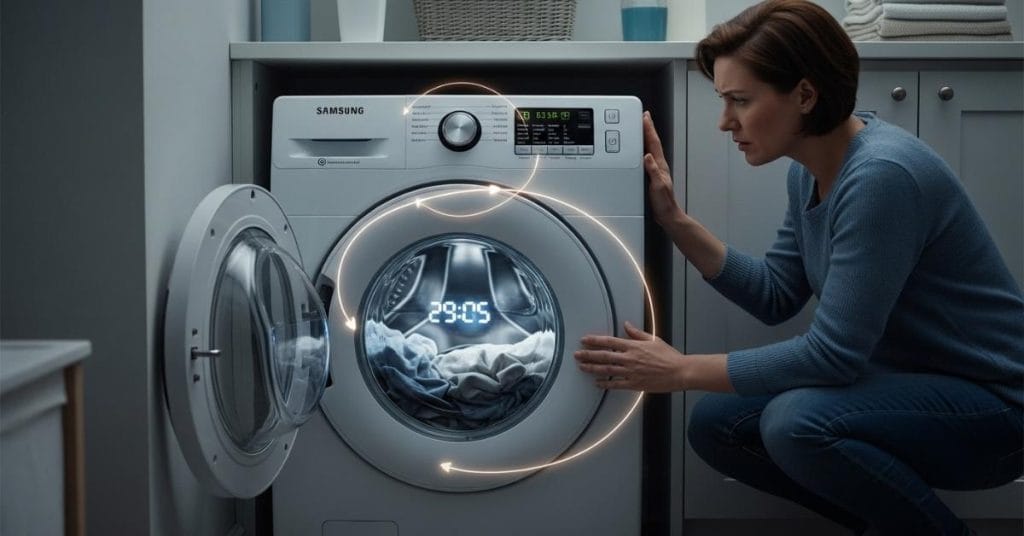
This is where things get frustrating. If your Samsung washing machine won’t finish its cycle, the problem is no longer a malfunction, but rather a malfunction or misconfiguration.
A common cause is a drainage problem. If the water isn’t draining properly, the machine can’t move on to the next step. It just keeps trying.
An unbalanced load of clothes can also cause the machine to get stuck on a cycle. It keeps trying to spin but fails to stabilize, resulting in the cycle never completing.
In some cases, a faulty sensor or control board issue is also to blame. These are less common but more serious, as they may require repair.
There’s also a simple explanation that many people overlook—the pause or delay settings. Sometimes the machine isn’t stuck; it’s just waiting because of the delayed start or soak option.
How to Fix Long or Stuck Cycle Times
A technician is not always needed. Many cycle time problems can be solved with a few simple adjustments.
Start by reducing the load size. Give the drum room to move freely. This alone can significantly reduce cycle time.
Check your water supply. Make sure the inlet valves are fully open, and the water pressure is stable. Clean filters regularly. This includes the lint filter and the drain filter. It’s a small step that makes a big difference.
Avoid overusing Eco mode during rush hour. Choose the right cycle for your situation rather than assuming that one setting fits all.
If the machine won’t drain, check the drain hose for any obstructions or kinks. A clogged hose can completely disrupt the cycle. And if the problem persists after all this, it’s time to consider having it inspected by a technician.
A Smarter Way to Estimate Cycle Times
Estimating how long it will take to wash clothes is a common mistake. It leads to a lack of planning and frustration.
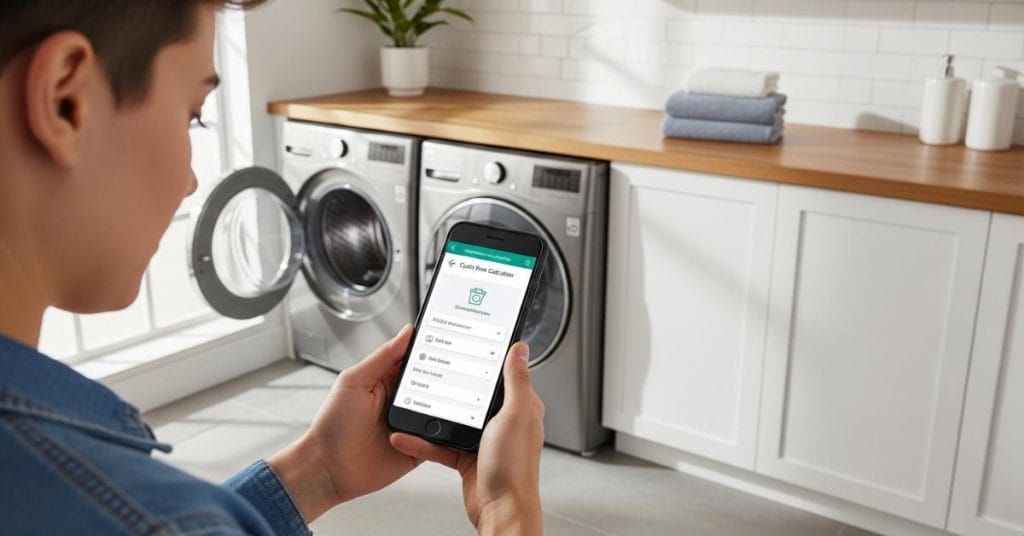
Instead of guessing, it’s better to use a reliable tool that calculates an estimated cycle time based on your load size and settings. Washeli, your site already has tools designed to make laundry decisions easier. Mentioning and using these tools in your daily routine can save time and avoid confusion.
When users understand how different factors affect laundry time, they can make better decisions—and avoid unnecessary delays.
Common Misconceptions About Samsung Washing Machine Cycles
Let’s clear up some common misconceptions that can confuse. A long wash doesn’t necessarily mean the machine is defective. In many cases, it means the machine is working efficiently.
Quick Wash is not suitable for heavily soiled clothes. If used incorrectly, it won’t clean clothes properly. Repeatedly turning the machine off and on again doesn’t solve the timing problem, but rather makes it worse.
And finally, not all delays are technical problems. Sometimes the machine is doing exactly what it was designed to do.
Understand Before You Assume
If your Samsung washing machine’s cycle time seems unusual, don’t jump to conclusions. Most of the time, the problem is either due to user behavior or a normal adjustment of the machine, not a malfunction.
But it’s also not wise to ignore recurring problems. If your Samsung washing machine is taking too long to complete a cycle or not completing at all, there must be a reason behind it, and now you know where to look.
The difference between frustration and control is understanding how your machine works.