
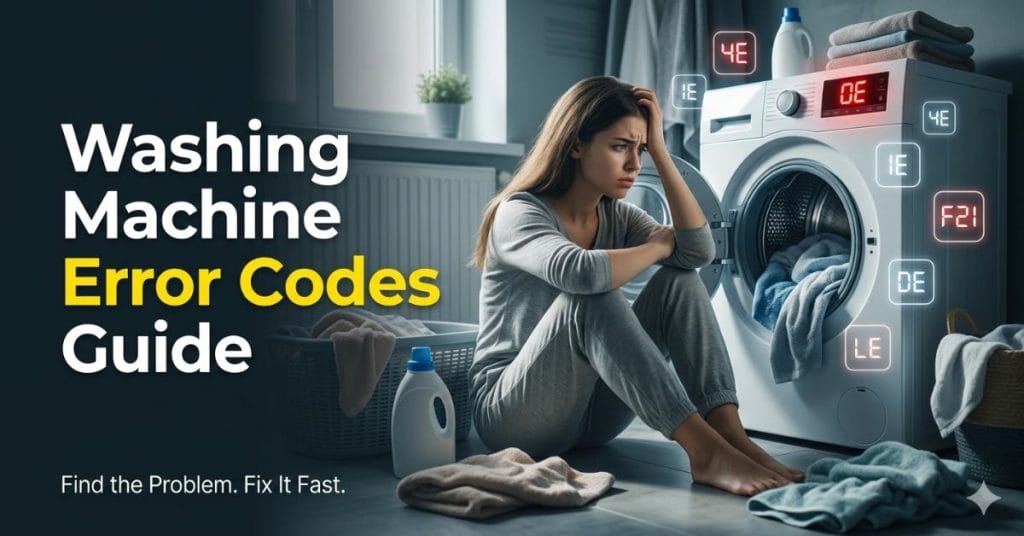
A washing machine doesn’t just stop working for no reason. Before there’s a problem, it tries to tell you something. The error code is a short, confusing combination of letters and numbers that most users don’t understand.
The reality is simple. These codes aren’t problems—they’re warnings. If you understand them early, you can fix most problems yourself. And if you ignore them, even minor problems can turn into expensive repairs.
This washing machine error code guide is designed to provide clarity, not confusion. Rather than a random list, this guide researches real problems from major brands like Samsung, LG, Whirlpool, Bosch, GE, Maytag, Electrolux, Haier, Panasonic, and Kenmore to see what’s really going on and explain how to fix them properly.
Why Error Codes Confuse Most Users
One of the main reasons people suffer from washing machine malfunctions is inconsistency between different brands. The same problem can appear under completely different codes from manufacturer to manufacturer.
A water supply problem can show up as “4E” on Samsung, “IE” on LG, and “F8 E1” on Whirlpool. To the average user, these may seem like three different problems. In reality, they all indicate the same thing: your washer is not getting enough water.
This inconsistency causes people to search multiple websites, read conflicting advice, and often apply the wrong solution. And that’s where most of the damage starts.
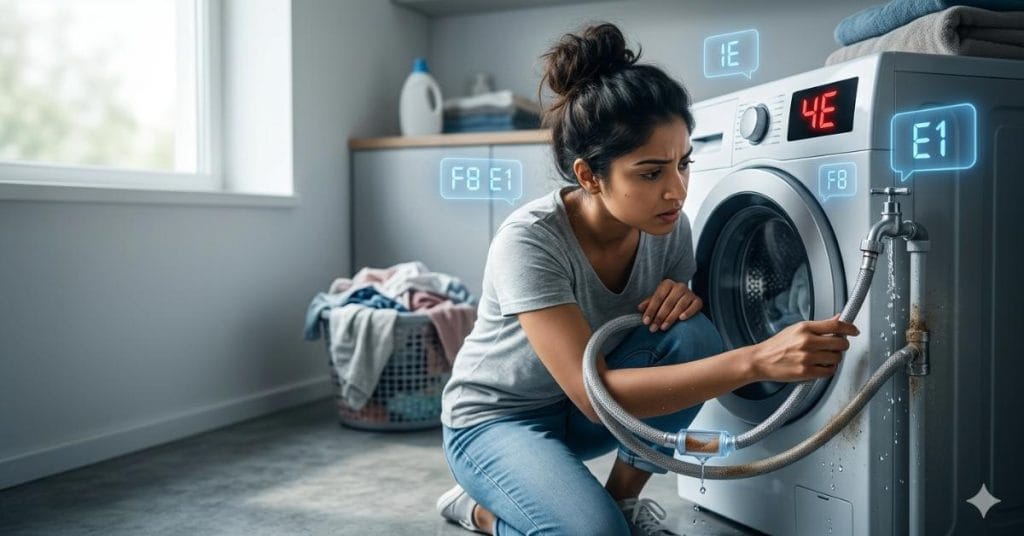
Water Supply Errors Across Brands (4E, IE, F8 E1, E1)
Water-related errors are one of the most common problems with all types of machines. Brands like Samsung, LG, Whirlpool, Haier, and Panasonic often display codes like 4E, IE, or E1 when water can’t enter the drum properly.
In real homes, this is rarely the case when there is a technical fault. Most of the time, the problem is simple, but it is ignored. Maybe the water tap is not fully open, the water pressure is too low, or the inlet filter is clogged with dirt and debris. In some cases, the hose pipe at the back of the machine is bent, blocking the water flow.
Users often think that something is broken inside and rush to call a technician. But in reality, the problem can be solved in minutes by checking the water line, cleaning the filter, and ensuring the correct pressure.
Drainage Problems That Stop Your Cycle (OE, E2, F21)
Another common problem occurs when the machine fills with water but does not want to drain. This is a common problem with Bosch, Maytag, GE, and LG machines, which is usually indicated by the code OE, E2, or F21.
The situation seems serious because your clothes are stuck in dirty water, but the root cause is often very simple. Over time, small objects like coins, threads, or lint clog the drain pump or hose pipe. Many users are not aware that their washing machine has a filter that needs to be cleaned regularly.
Neglecting this maintenance can lead to repeated problems with draining water. In fact, users often encounter the same problem over and over again, because they have not cleaned the pump filter once.
Door Lock Errors That Prevent the Machine from Starting (DE, DL, FDL)
Front-load washers rely heavily on a secure door lock. If the machine senses that the door is not closed properly, it will not start. This is why brands like Electrolux, Samsung, LG, and Kenmore often display error codes like DE, DL, or FDL.
What most people don’t realize is that it’s not always a hardware failure. In many real-world cases, this problem is caused by too much laundry in the drum or clothing getting stuck in the door gap. This prevents the latch from fully locking.
Sometimes the solution is to remove a few clothes or close the door tightly. But if ignored repeatedly, this can eventually damage the locking mechanism.
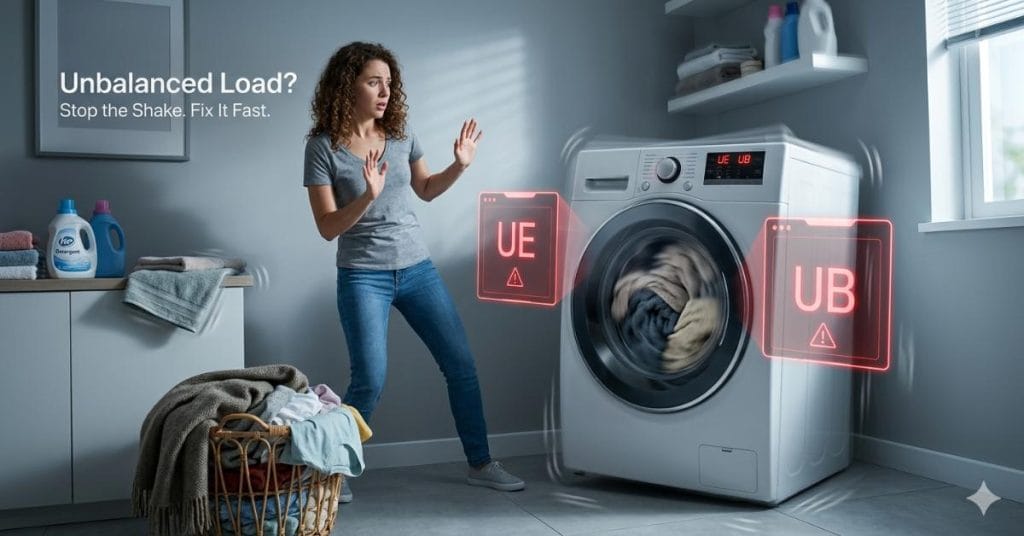
Unbalanced Load Errors That Cause Violent Shaking (UE, UB)
If your washing machine starts to vibrate violently or stops mid-spin, you’re probably experiencing an ‘unbalanced load’ error. Brands like LG, Haier, Panasonic, and Samsung display this as UE or UB.
This isn’t a fault with the machine—it’s a problem with user behavior. Washing a single heavy blanket or mixing heavy and light clothes together causes uneven weight distribution inside the drum. The machine detects this imbalance and stops to prevent internal damage.
In reality, this is one of the most misunderstood errors. People think the machine is faulty when the real problem is loading the clothes incorrectly.
Overheating and Motor Errors (LE, F02, E3)
Motor or overheating related errors are more serious and are commonly seen on Whirlpool, Maytag, GE, and Samsung machines. Codes like LE, F02, or E3 indicate that the motor is overloaded or overheating.
This often occurs when the machine is repeatedly overloaded or cycled continuously without allowing the machine time to cool down. In some cases, internal wiring or components may be involved.
Unlike common errors, this is not something to ignore. Continuing to run the machine in this condition can cause permanent damage.
Excess Foam and Detergent Misuse (SUD, SD)
Modern washing machines from brands like LG, Whirlpool, and Bosch are designed to detect excess suds. When too much suds are produced, the machine displays an error such as SUD or SD.
This happens when users use regular detergent instead of high-efficiency (HE) detergent, or use more detergent than necessary. This results in the machine not cleaning properly and puts stress on the internal components.
This is a very common problem in real life, as many users think that more detergent means cleaner clothes. But in reality, it has the opposite effect.
The Smarter Way to Fix Error Codes
The biggest mistake users make is guessing. They search randomly, trying different solutions, and often making the situation worse.
A more intelligent approach is to have a well-organized troubleshooting. Instead of having to jump around to different websites, your Washly platform already provides a more effective solution. The washing machine error code tool on your site helps users select their brand and instantly identify the problem with the right solution.
This eliminates confusion and reduces the risk of applying the wrong solution. It also saves time, especially when dealing with brand-based variations of the same problem.
Why Most Washing Machine Problems Repeat
There is a specific pattern behind repeated errors. It’s not just about the machine—it’s about usage habits.
Many users routinely put extra clothes in their machines, ignore the cleaning filter, use the wrong detergent, and select the wrong wash settings. Over time, these habits lead to the same errors over and over again.
It’s important to understand that fixing the error once isn’t enough. You need to fix the behavior that caused it.
The Hidden Connection Between Error Codes and Wash Modes
One thing that most guides don’t explain is the relationship between washing modes and error codes. The mode you choose directly affects the performance of your machine.
Using heavy-duty mode for light fabrics can cause imbalance issues. Running a quick wash with a full load can result in incomplete cycles and drainage errors. Incorrect temperature settings can cause sensor-related issues.
Many users repeatedly encounter problems because they don’t understand how to use the machine properly. If you want to prevent problems before they occur, it’s essential to have an understanding of wash modes.
For a complete explanation of how different modes work and when to use them correctly, you can read this detailed guide: washing machine mode guide
When You Should Stop and Call a Technician
While many problems can be fixed at home, not all problems should be handled without professional help. If you notice a burning smell, electrical tripping, internal leakage, or repeated motor malfunctions, it is best to stop using the machine immediately.
Attempting to fix serious internal problems without the proper knowledge can turn even a repairable problem into a complete failure.
Final Tips
There’s nothing to be afraid of with washing machine error codes. They’re designed to keep your machine safe and guide you through the process of finding the problem.
The difference between a simple fix and a costly repair often depends on how you respond to that code. Ignoring it causes damage. Guessing it causes mistakes. Understanding it brings control.
Most of the problems you encounter are not unique. They happen every day with different brands of washing machines. Once you understand these patterns, you’ll stop reacting emotionally and start solving problems logically.
And if you want to make that process even faster and more accurate, our Washely tool already makes it easy, helping users go from confusion to clarity in seconds.