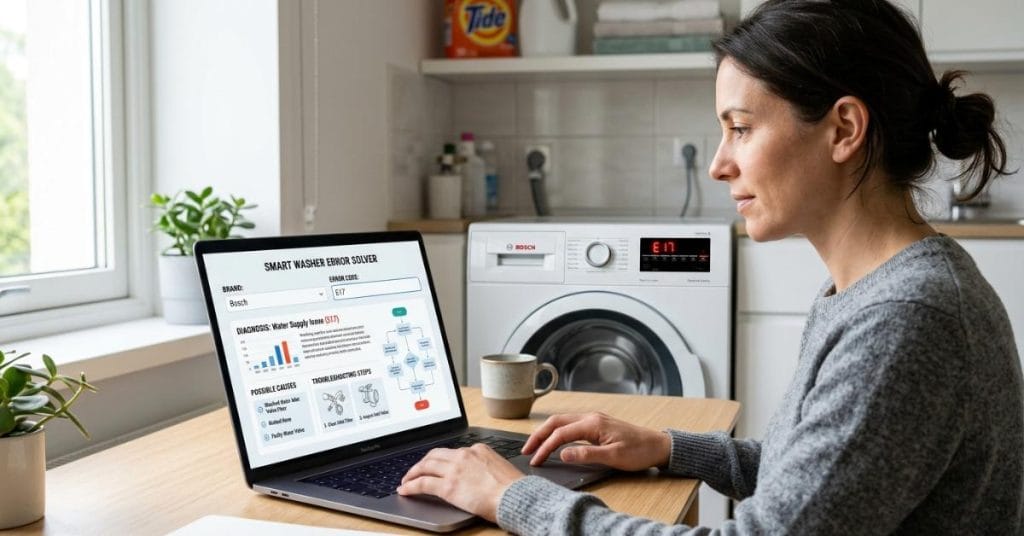
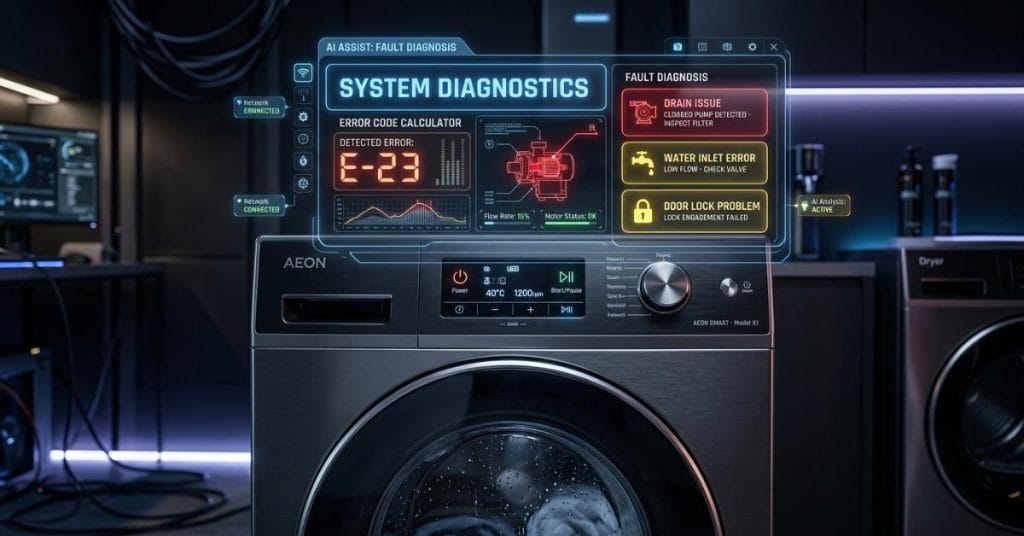
Select your brand, enter the error code, and hit Check Error. Instantly see the problem, the fix, and how serious it is. Covers 10 major US brands — Whirlpool, Samsung, LG, Maytag, GE, and more — with 150+ error codes. Stop guessing. Fix it yourself and save hundreds on service calls.
Look Up Your Washing Machine Error Code and Fix It Today
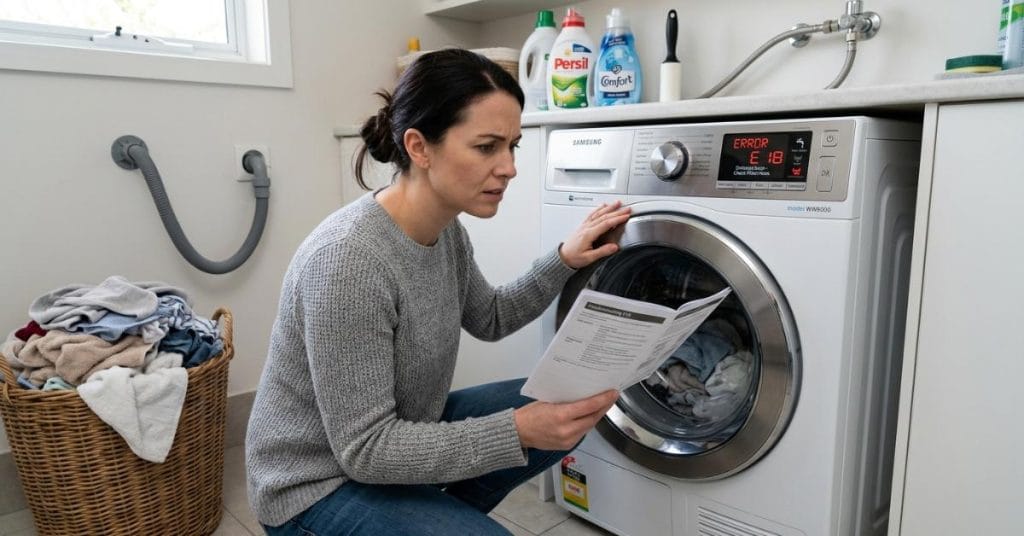
There’s nothing more frustrating than walking into your laundry room, tossing in a load of clothes, and coming back to find your washer flashing some random combination of letters and numbers. What does F9E1 mean? What about OE, 5E, or Sud? Most people have absolutely no idea — and that’s exactly why we built this free washing machine error code lookup tool.
Whether you own a Whirlpool, Samsung, LG, Maytag, GE, or any other major US brand, this tool helps you instantly understand what your washer is trying to tell you — and more importantly, what you can actually do to fix it.
What Is a Washing Machine Error Code?
Modern washing machines are a lot smarter than they seem. Inside each washer are dozens of sensors that constantly monitor water levels, motor speed, door locks, drain functionality, temperature, and more. When one of these sensors detects something out of the ordinary, the machine doesn’t just stop and leave you in limbo; it displays an error code on the display.
This error code is your washer’s way of saying, “Here’s what went wrong.” The problem is, each manufacturer has its own code system. A Samsung 4E means something completely different than a Whirlpool F8E1, even though both are water supply errors. Without the right information, you’ll be stuck. And that’s where a reliable washing machine error code checker makes all the difference.
Why Most People End Up Calling a Technician They Didn’t Need
Here’s a number that might surprise you: The average cost of an appliance service call in the United States is between $100 and $300, and that’s without the cost of any parts.
For a simple problem like a clogged drain filter or a water hose pipe that’s been installed upside down, you probably didn’t need to spend that much money. The truth is, most washer error codes — especially low and medium severity codes — can be resolved in less than 30 minutes without any tools or experience. For example: Redistributing an unbalanced load to clear a UE error. Cleaning a clogged pump filter to fix a slow drain problem. Reversing the hot and cold water hose pipes to clear a 4C2 or HC code. Reducing the amount of detergent to prevent a Sud or F0E2 error from coming back. Pressing the control lock button to clear a LOC code that disables the entire panel.
None of these requires a service appointment. All they need to do is know what the code actually means — and this tool gives you exactly that.
How Washing Machine Error Code Tool Works
This tool is super easy to use. Select your washer brand from the dropdown — we have products from Whirlpool, Maytag, GE, LG, Samsung, Kenmore, Amana, Speed Queen, Electrolux, and Frigidaire brands. Then select your error code from the list or type it directly into the search bar. Click ‘Check Error’ and within seconds you’ll see the problem, its suggested solution, and a severity rating, so you can understand how urgent it is.
Here’s how the severity system works. Low-severity codes are almost always self-fixable and can be resolved in a few minutes. Medium-severity codes usually have issues like the drain pump filter, water inlet screen, or door latch — these can also be fixed at home with a little patience.
High-severity codes have issues like the control board, motor failure, or internal leaks — these may ultimately require a technician, but the tool helps you run basic tests first so you don’t have to call someone before you can fix common problems.
If you want to know more, click the ‘Get Step-by-Step Repair Guide’ button. Our AI creates a detailed, easy-to-follow repair guide based on your specific brand and error code — what to check first, what to replace if necessary, and whether to call a professional.
The Most Common Washing Machine Error Codes in the US
After working through hundreds of error codes across every major brand, a few categories come up more than any others.
Drain errors are probably the single most common reason people see an error code. Codes like OE on LG, 5E or nd on Samsung, F9E1 on Whirlpool, and F21 on Kenmore all mean the same thing — water is not draining fast enough. Nine times out of ten, the fix is cleaning the pump filter, which is usually located behind a small access panel at the front bottom of your machine. It takes about ten minutes.
Water supply errors are the second most frequent. If your washer isn’t filling properly, you might see 4E or 4C on a Samsung, IE on an LG, F8E1 or LF on a Whirlpool or Maytag, or E1 on a GE. Before assuming anything is broken, check that both hot and cold supply valves behind your machine are fully open and that the inlet hose screens aren’t clogged with sediment.
Door and lid lock errors frustrate a lot of people because the machine just refuses to start. On Samsung, that’s a dE code, on LG, it’s dE or dE1, on Whirlpool and Maytag, it shows as F5E1 or F5E2. Usually, this means something is caught in the door gasket, the latch isn’t fully closing, or — on top-load machines — the lid switch needs to be replaced.
Excess suds errors, shown as Sud, Sd, or F0E2 depending on the brand, are almost entirely caused by using regular detergent instead of HE detergent in a high-efficiency washer. If you’ve been grabbing whatever’s on sale without checking the label, this is almost certainly your problem. Run an extra Rinse and Spin cycle and switch to HE detergent going forward.
Does Your Brand Matter?
Absolutely. Washing machine error codes are not universal — a code that means one thing on a GE might mean something completely different on an Electrolux. That’s why it’s critical to identify your brand before looking anything up. Our tool covers all ten of the most popular washer brands sold in the United States, and the error code database is built directly from official manufacturer documentation so you’re not getting guesswork.
For Whirlpool and Maytag owners, the F-code system (F1E1, F9E2, etc.) is the standard across most modern front-load and top-load HE models. Samsung uses a mix of number codes like 4E, 5E, and 3E alongside letter codes like UE and LE. LG sticks mostly to two-letter codes like OE, IE, and LE. GE uses a simpler E1 through E9 system. Knowing your brand’s code format makes it a lot easier to search accurately.
When Should You Actually Call a Technician?
Not all error codes are fixable by yourself, and this tool doesn’t claim to be either. If your machine is showing a serious code like F1E1 (Main Control Board), F7E1 (Motor Error), or E7 (Speed Queen Machine Transmission Error), and basic troubleshooting doesn’t work, it’s time to call a professional.
The same goes for visible water dripping from the bottom of the machine, a burning smell, or the error code coming back repeatedly after clearing it. The key is to use the tool first. Follow the simple steps.
Unplug the washer for a minute and turn it back on. Clean the filter. Check the hoses. Most of the time, a simple fix will fix the problem. Only call a technician after you’re sure the problem isn’t really fixable by yourself — and when you do, you’ll already know exactly what the problem is, saving you both time and money on the diagnostic portion of the service call.
Save Time, Save Money, Fix It Yourself
Americans spend billions of dollars each year on appliance repair service calls — many of which could have been avoided with the right information at the right time.
This tool is designed to fill that gap. Whether your Whirlpool washing machine is leaking water, your Samsung machine is showing an OC overflow code, your LG machine is stuck on a UE code, or your Maytag machine won’t open its lid, you deserve a straight answer before you have to sift through a 200-page owner’s manual or wait three days for a service appointment.
Bookmark this page. The next time your washing machine shows a code, come here first. Check the error, read the solution, and most of the time you’ll have clean clothes back by the end of the day. Your washing machine is talking to you. Now you can really understand what it’s saying.