
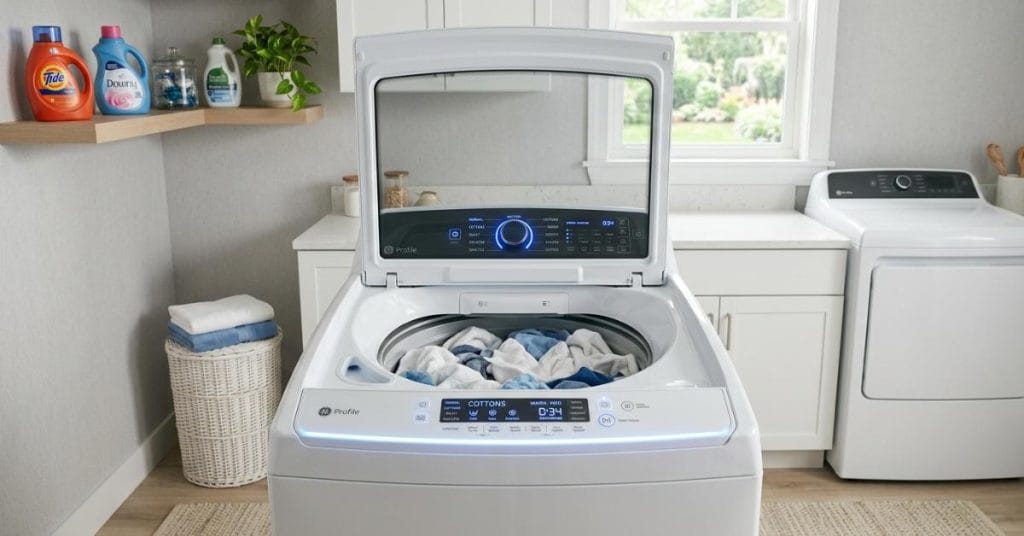
If you’ve ever felt like your washing machine has more options than you realize, you’re not alone. Modern washers, especially those from GE Appliances, are packed with advanced features that go beyond the simple task of washing and spinning. They’re designed to optimize the cleaning process, protect fabrics, and increase efficiency. But here’s an uncomfortable truth: Most users barely use the power of these machines.
What happens as a result? Clothes don’t come out as clean as they should, fabric quality deteriorates quickly, and small problems become bigger, simply because the machine isn’t being used properly.
This guide is designed to fill that gap. You’ll understand how GE washing machine modes actually work, how each cycle behaves, how to fine-tune settings for different types of fabrics, and how to troubleshoot common problems and error codes like an expert.
How GE Washing Machines Work
Before you dive into the modes and settings of a GE washing machine, you need to understand the workings behind the machine. GE washers are built on a controlled process that includes sensing, washing, rinsing, and spinning, but what sets them apart from others is how they adapt to each step.
When you start a cycle, the washer doesn’t immediately fill with water and start washing. Instead, it often starts by sensing the load. It determines how much laundry is inside and adjusts the water level and wash duration accordingly. This is why sometimes your washer stalls at the start. It’s not broken, it’s thinking.
On models with smart features, you can connect the washer to an app like SmartHQ, which adds another layer of control. You can monitor cycles, get alerts, and even diagnose problems remotely.
But no matter how smart the washer is, the final result ultimately depends on one thing: your choice.
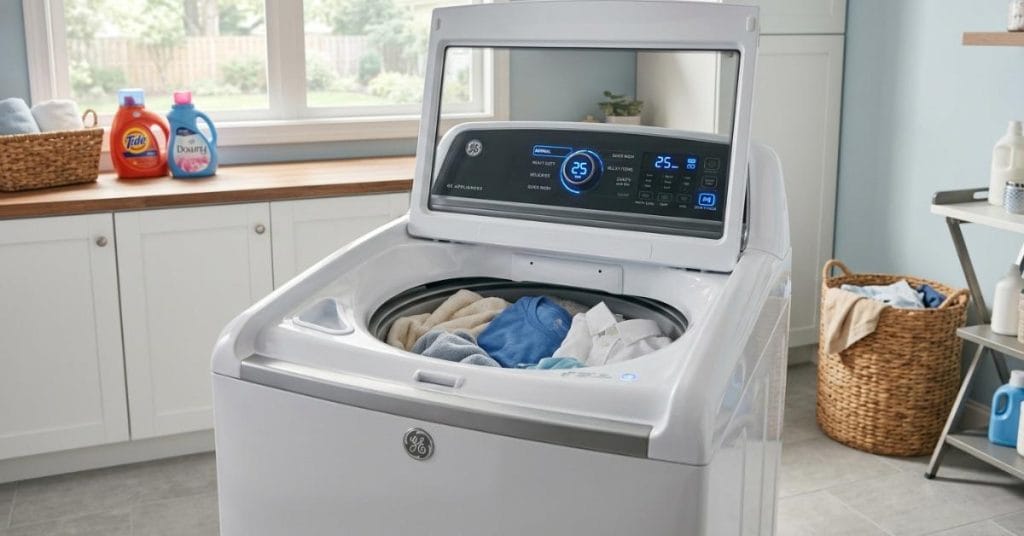
GE Washing Machine Modes & Cycles Explained
Each cycle on a GE washing machine is designed for a specific type of fabric. The mistake most people make is choosing a cycle based on habit rather than purpose.
GE Normal Cycle: The Balanced Workhorse
The Normal cycle is designed for everyday use. It can handle a variety of fabrics at once and balances cleaning power with fabric care. This cycle uses medium agitation and a normal spin speed, making it safe for most types of clothing.
In fact, this should be your default option. If you’re constantly switching from the Normal cycle to another cycle, you’re either overthinking it or you’re unknowingly using the machine incorrectly.
GE Heavy Duty Cycle: When Dirt Is the Priority
Heavy-duty is designed for performance, not fabric protection. It uses intense agitation, high temperatures, and long cycles to break down stubborn dirt.
This is ideal for items like:
- Work uniforms
- Towels
- Heavily soiled outdoor clothing
However, using this cycle on everyday clothing is unnecessary and harmful. Over time, it weakens the fabric fibers and shortens the life of your clothing.
GE Delicates Cycle: Controlled and Gentle
The Delicates cycle reduces the intensity of agitation and spinning. It is designed for delicate fabrics that cannot withstand rough use.
What many users misunderstand is that “delicate” does not mean ineffective. This cycle cleans clothes but in a controlled way that protects the fabric’s structure.
If you wash items labeled “hand wash,” this cycle is the safest machine option for you.
GE Quick Wash: Fast but Limited
The main purpose of Quick Wash is to save time. It significantly reduces the washing time, so it is ideal for lightly used clothes.
But it also has a disadvantage. Less time means less cleaning. If your clothes are really dirty, Quick Wash will not give you the results you expect. It is a convenient feature, not a substitute for a full cycle.
GE Bulky / Bedding Cycle: Solving a Real Problem
Large items behave differently inside the washing machine. They absorb more water, move unevenly, and can cause imbalances during the spin cycle.
The Bulky Cycle solves this problem by raising the water level and adjusting the speed of the drum. This ensures that large items are cleaned evenly without creating excessive vibration.
GE Sanitize Cycle: High-Temperature Cleaning
The Sanitize cycle uses high heat to eliminate bacteria and allergens. It’s particularly useful for:
- Baby clothes
- Towels
- Hygiene-sensitive fabrics
However, this cycle consumes more energy and can be harsh on certain fabrics. Using it regularly without need is inefficient.
GE Rinse & Spin and Drain & Spin: Small Features, Big Impact
These cycles are often ignored, but they’re essential in real-life situations. Rinse & Spin helps remove excess detergent, while Drain & Spin removes water when a cycle is interrupted.
Knowing when to use them can save you from restarting entire wash cycles unnecessarily.
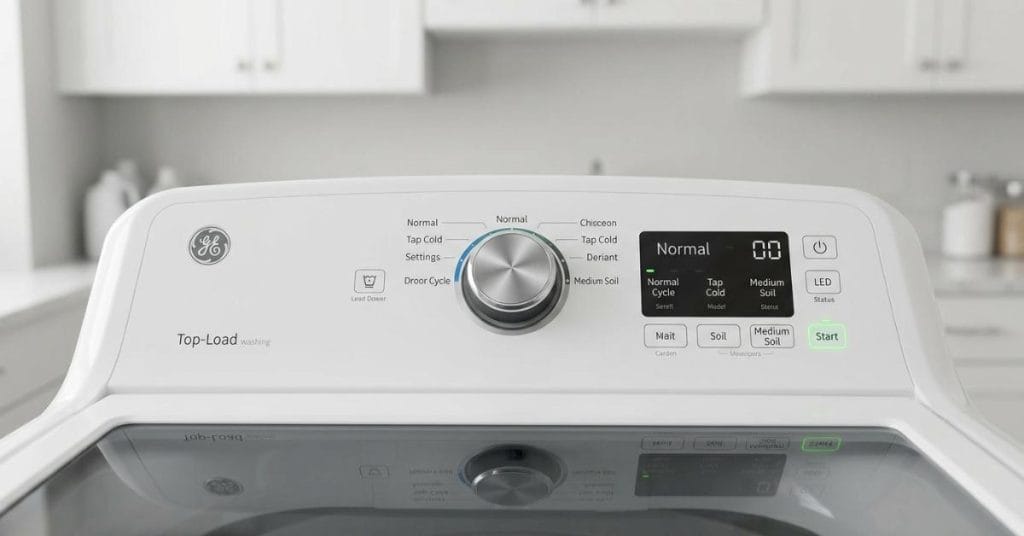
GE Washing Machine Settings Explained (Where Control Happens)
Cycles define structure, but settings define behavior. This is where most users either get things right—or completely mess things up.
Water Temperature: Strategic Use Matters
Cold water is the most underrated option. It preserves the color of fabrics, reduces energy consumption, and works well with modern detergents.
Warm water is balanced, clean, and suitable for most fabrics. While hot water is powerful, it should be used sparingly for heavily soiled items or for disinfecting.
Always using hot water is one of the most common mistakes—and it’s also the easiest to fix.
Spin Speed: More Than Just Drying
Spin speed determines how much water is removed from the fabric. Higher speeds dry the fabric faster, but they also put more stress on the fabric.
Lower speeds dry the fabric more gently, but they leave the fabric more damp. Choosing the right spin speed involves balancing efficiency with fabric care.
Soil Level: Stop Overestimating Dirt
The level of soil determines how long and how vigorously the washer cleans. Most users choose “Heavy,” thinking it’s better—but it’s not.
For lightly or moderately soiled clothes, using a heavy soil level wastes time and energy and causes unnecessary damage to the clothes.
Load Size and Auto Sensing: The Hidden Efficiency Feature
GE washers often have auto-sensing technology, which automatically adjusts the water level. This increases efficiency and prevents waste of resources.
But despite this feature, overloading the washer remains a major problem. If clothes are loaded too tightly, they don’t spin properly, and the cleaning power is significantly reduced.
Smart Features: Useful, But Not a Shortcut
Modern GE washers have smart features that connect to apps like SmartHQ. These allow for remote control, notifications, and diagnostics.
While convenient, these features are no substitute for proper use. A smart washer still relies on selecting the right cycle and settings.
Common GE Washing Machine Problems (And Real Fixes)
- Even the best machines have problems. The difference is, you don’t know what’s going on.
- If your washer won’t spin, it’s often because the clothes are unbalanced. Rearranging the clothes usually solves the problem.
- If your washer won’t drain, the problem is usually a clogged hose or pump. Regular maintenance can help prevent this.
- Noise is another common complaint. In many cases, it’s not due to a mechanical fault, but rather due to an incorrect load level or an overloaded load.
- By recognizing these signs, you can quickly troubleshoot the problem without assuming the worst.
GE Washing Machine Error Codes (Detailed Breakdown)
Error codes are diagnostic signals, not random numbers.
An E1 error usually indicates a water supply problem. This could mean that the valves are closed or the water pressure is insufficient.
An E2 error indicates a water drain problem, which is often caused by a blockage. Door or lid lock errors occur when the washer senses that it is not closed properly.
Different models may have additional codes, but most operate in the same way: they indicate common problems that can be resolved with a few basic checks. Ignoring these codes can lead to bigger problems.
Maintenance: The Difference Between 3 Years and 10 Years
The lifespan of a washing machine depends largely on its maintenance.
Regular drum cleaning can prevent dirt and odors. Checking the hose pipe ensures proper water flow. Using the right amount of detergent can prevent residue buildup that can damage both cleaning performance and internal components.
These simple habits, like keeping the washer flat and avoiding overloading, make a significant difference over time.
GE Washing Machine Troubleshooting Mindset
When a problem occurs, don’t panic. Start with the basics.
Check the power supply, water connection, and load balance. Most problems are caused by simple reasons, not complex faults.
Solving problems logically saves time, money, and unnecessary stress.
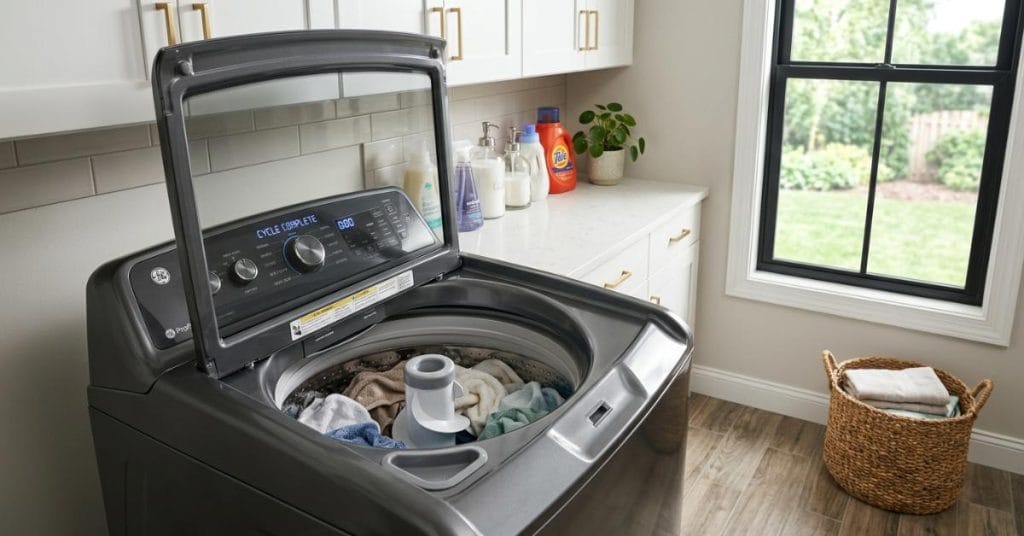
GE Washing Machine Top Load
GE top-load washing machine models are one of the most efficient choices for everyday laundry, especially in U.S. households where convenience and speed are both important. Unlike front-load machines, top-load washers allow you to add clothes without having to bend down, and often provide an opportunity to add forgotten items mid-wash.
Most GE top-load washers have an agitator or impeller. Agitator models have a central post that vigorously agitates clothes, which helps remove heavy soil. Impeller models, on the other hand, use lower fins to agitate clothes, which provide better care for clothes and a gentle wash with improved energy efficiency.
The mistake that users make is simple: overloading. While top-load machines look spacious, overfilling them can hinder proper water flow and fabric movement. This results in uneven cleaning of clothes and puts extra strain on the internal components.
For best results, balance the load, use the correct cycle for the type of fabric, and resist the temptation to wash everything at once. A top-load washer, used properly, is fast, efficient, and long-lasting.
GE Washing Machine Parts
Knowing the parts of a GE washing machine is not about being a technician, but rather about knowing what the possible cause is if something goes wrong.
A washer is made up of a few key parts. The drum holds the clothes, and the agitator or impeller moves them through the water and detergent. The motor powers this movement, and the pump drains the water from the machine. The control panel controls all the settings, and safety features like a drain switch or door lock ensure that the washer only runs when it is properly closed.
Most common problems are caused by one of these parts. For example, if your washer isn’t draining, it’s usually a problem with the pump or hose. If it’s not turning, the problem could be related to the motor, drain switch, or load balancer.
You don’t need to open your machine, but having a basic understanding of what to do can help you take quick action and avoid unnecessary service calls.
GE Washing Machine Not Draining
GE washing machine not draining is one of the most annoying problems, as it can cause clothes to get wet and the wash cycle to not complete.
In most cases, the problem is caused by an obstruction. The drain hose can be clogged with lint or dirt, or it can be kinked and prevent water from draining. Sometimes the problem is inside the pump, where small objects like coins or lint can get stuck.
Start with the simplest of checks. Look at the hose and make sure it’s not kinked or clogged. If that’s the case, the next step is to check the inside of the pump, which may require opening a panel depending on the model.
Ignoring this problem can damage the pump over time, which is more expensive to repair. So it’s wise to address it early.
GE Washing Machine Won’t Spin
When your GE washing machine won’t spin, it can be easy to think that something serious is broken. In reality, the cause is often very simple.
The most common cause is an unbalanced load. When the load is unevenly distributed, the washer will stop spinning to protect itself. This is especially common with large items like blankets or towels.
Another possibility is a lid or door problem. If the washer doesn’t sense that it’s closed properly, it won’t enter the spin cycle. In some cases, a worn lid switch may be the cause.
In relatively rare cases, the problem may be related to the motor or internal components. But before assuming the worst, always check the load balance and general functionality first. Most spin problems are caused by the user, not mechanical failure.
GE Washing Machine Drain Hose
The drain hose of your GE washing machine plays a very important role in how efficiently your washer will work. It is responsible for draining the dirty water after each cycle, and even a small problem here can disrupt the entire process.
If a hose is bent, clogged, or incorrectly installed, it can block the water from draining. This can lead to water pooling in the drum, increasing cycle times, and the possibility of odors.
Proper installation is essential. The hose should be installed at the right height and should not be inserted too far into the drain pipe. If it goes too deep, it can create a siphoning effect, causing water to back up into the washer.
Regular inspections can prevent most problems. Make sure the hose is clean, straight, and properly connected. It’s a small thing, but it has a big impact on its performance.
GE Washing Machine Filter
The GE washing machine filter is one of the most overlooked parts of the machine, yet it plays a major role in keeping your washer running smoothly.
This filter traps lint, dirt, and small particles during the wash cycle. Over time, it can become clogged, which reduces the efficiency of water drainage and affects overall performance.
Not all GE washers have an easily accessible filter, but if your model does, it is essential to clean it regularly. A clogged filter can cause slow water drainage, bad odors, and even error codes to appear.
The process is usually simple. Find the filter, clean the dirt that has accumulated on it, rinse it with water, and reinstall it. Doing this once a month can significantly increase the efficiency and lifespan of your washer.
On the other hand, ignoring it can lead to problems that could have been avoided entirely.
A GE washing machine is not complicated; it’s perfect. The difference between mediocre and excellent results depends on how well you understand it.
Most users don’t have bad machines. Their understanding is incomplete. Once you fix that problem, everything improves—cleaning ability, fabric care, performance, and long-term reliability.
And that’s the real goal: not just using your washer, but using it the right way.